Views: 0 Author: Site Editor Publish Time: 2026-03-01 Origin: Site
Fire Monitors help put out fires in big places. They shoot water or foam fast to stop fire and keep people safe.
IS 8442:2008 gives rules for Fire Monitors. These rules make sure Fire Monitors are safe, work well, and can be trusted in emergencies.
Pick the right Fire Monitor size and type for your needs. Large areas need Fire Monitors that spray more water and reach farther.
Always pick Fire Monitors that are certified. Check for the right labels to make sure they are safe and work well.
Test your Fire Monitor often to make sure it works. Use the steps in IS 8442:2008 to check how it works.
A Fire Monitor is a strong tool for fighting fires. It sprays water or foam over big areas. You can point the stream at dangerous places. This helps protect people and things. The Fire Monitor sits on a post. It connects to a water supply. You use handles to move the nozzle up or down. You can also turn it side to side. This lets you aim the water where you need it.
A Fire Monitor has many important parts. Each part helps you fight fires fast and safely.
Component | Description |
|---|---|
Base flange | The part that holds the monitor in place. |
Reducer | Changes pipe size if needed. |
Water barrel | Made strong so it lasts long. |
Elbow 90° and 45° | Turns the water flow in different directions. |
Swivel joint | Lets you move the monitor up, down, or sideways. |
Lock handles | Keeps the monitor steady. |
Nozzle | Points the water where you want. |
Handle or worm and worm wheel | Helps you move the monitor up and down. |
Drain valve | Lets you empty water after using the monitor. |
International rules like NFPA and IBC talk about fire monitors too. They say fire monitors help control alarms and sprinkler systems. These rules make sure you get good protection in many buildings.
Fire Monitors are used where fires can happen easily. Factories need strong tools because fires spread fast. Firefighters use these monitors to keep cities safe. You also see them at airports, docks, and ships. Each place uses the monitor to protect people and nature.
Application Type | Specific Uses |
|---|---|
Industrial Facilities | Oil refineries, chemical plants, power stations, warehouses, big factories |
Municipal Fire Protection Systems | Airports, hangars, city fire systems, fire brigades, emergency teams |
Marine and Offshore Safety | Oil and gas terminals, ports, offshore platforms, ships, docks |
A Fire Monitor acts fast and sprays strong streams. This stops fires from getting bigger. You can count on these tools to work well in hard situations. They help keep your community safe.
You need to understand why IS 8442:2008 matters when you choose a Fire Monitor. This standard sets clear rules for stand post type water and foam fire monitors. It tells you how to build, test, and use these devices. The main goal is to keep people safe and make sure the equipment works every time. IS 8442:2008 covers monitors that you see in factories, airports, and other places where fires can cause big problems. You get guidance on how much water or foam the monitor should spray and how strong the parts must be.
IS 8442:2008 helps you trust your Fire Monitor. You know it will perform well in emergencies.
You see that the standard focuses on monitors that stand on posts. These monitors connect to water or foam supplies. You can use them to protect large spaces. The rules make sure the monitor can handle tough conditions and last a long time.
IS 8442:2008 has changed over time. You benefit from these updates because they improve safety and reliability. The standard first appeared to guide the design of fire monitors. Later, experts added new materials and better testing methods. You now see requirements for copper alloy and stainless steel. These materials resist rust and damage. You get a monitor that stays strong even after years of use.
Here is a quick look at the main materials:
Material | Reason for Use |
|---|---|
Copper Alloy | Resists corrosion and lasts long |
Stainless Steel | Strong and easy to clean |
You also notice that the standard includes new ways to test performance. You must check that the monitor sprays water or foam at the right speed and pressure. The updates help you choose equipment that meets modern needs.
Tip: Always look for the latest version of IS 8442:2008 when you buy or install a Fire Monitor.
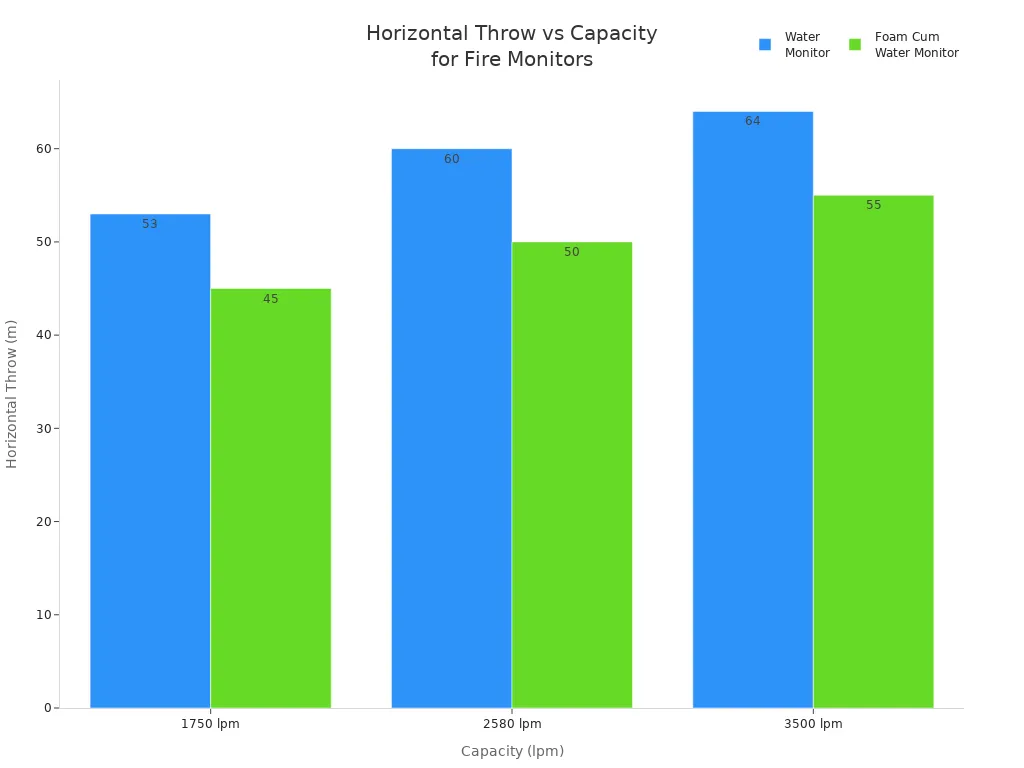
You need to know the right size and discharge rate when you choose a Fire Monitor. IS 8442:2008 gives clear numbers for both water and foam monitors. The standard lists three main capacities. Each one fits a different need. You can see the details in the table below.
Type of Monitor | Capacity (lpm) | Horizontal Throw (m) |
|---|---|---|
Water Monitor | 1750 | 53 |
2580 | 60 | |
3500 | 64 | |
Foam Cum Water Monitor | 1750 | 45 |
2580 | 50 | |
3500 | 55 |
You can compare how far each monitor throws water or foam. Water monitors reach farther than foam monitors at the same discharge rate. The chart below shows the difference in throw distances for each type.
You must match the monitor size and throw to your site’s needs. Bigger factories may need higher discharge rates and longer throws.
IS 8442:2008 tells you which materials to use for building a monitor. You get strong parts that last a long time. The standard lists copper alloy and stainless steel as the main choices. These materials resist rust and damage. You can clean stainless steel easily. Copper alloy stays strong even in tough weather.
Tip: Choose monitors made from these materials for better safety and longer life.
You also need to check the construction. The monitor must have a solid base flange. The nozzle and barrel must handle high pressure. Swivel joints let you move the monitor easily. Lock handles keep it steady when you aim the stream.
You must test each monitor before you use it. IS 8442:2008 gives clear rules for performance. The monitor must spray water or foam at the right speed and pressure. You need to check the horizontal throw distance. The monitor must not leak or break under pressure.
You can follow these steps for testing:
Connect the monitor to a water or foam supply.
Measure the discharge rate and throw distance.
Check for leaks at all joints and valves.
Test the movement of the nozzle and handles.
Inspect the monitor after testing for any damage.
Note: Testing helps you find problems early. You can fix them before an emergency happens.
You must look for proper marking and certification on every monitor. IS 8442:2008 requires clear labels. The monitor must show the manufacturer’s name, model, and capacity. You need to see the standard number on the label. This proves the monitor meets all rules.
You also need certification from a trusted agency. The certificate shows the monitor passed all tests. You can trust certified monitors to work well in emergencies.
Look for these markings:
Manufacturer’s name
Model number
Capacity (lpm)
Standard number (IS 8442:2008)
Always check the label and certificate before you buy or install a monitor.
You see the stand post type as the main design in IS 8442:2008. This type stands tall and connects directly to a water or foam supply. You can spot it in open spaces like factory yards or airport hangars. The stand post lets you aim the stream in many directions. You control the nozzle with handles or wheels. You get a strong base that keeps the monitor steady during use.
Stand post monitors help you reach fires quickly. You can move the nozzle up, down, or sideways to cover large areas.
Here are some features you should know:
Fixed installation on a post or pedestal
Easy access for firefighters
Swivel joints for flexible movement
Lock handles for steady aim
You can trust this type to work well in tough conditions. The design makes it easy for you to operate and maintain.
IS 8442:2008 covers two main types based on what they discharge. You can choose water monitors or foam monitors depending on your needs.
Monitor Type | Use Case | Discharge Medium |
|---|---|---|
Water Monitor | General fire protection | Water |
Foam Monitor | Oil, chemical, or fuel fires | Foam |
Foam Cum Water | Flexible for both fire types | Foam and Water |
Water monitors help you fight fires in warehouses and factories. Foam monitors work best for oil and chemical fires. You can select foam cum water monitors for places that need both options.
Tip: You should match the monitor type to the risks at your site. Water works for most fires. Foam helps with flammable liquids.
You get clear guidance from IS 8442:2008. The standard tells you how much water or foam each monitor should discharge. You can rely on these monitors to protect your facility.
You now know that fire monitors help protect large spaces from fire. IS 8442:2008 gives clear rules for building and testing these devices. You must check the size, discharge rate, and materials before choosing a monitor. Stand post and water or foam monitors fit different needs.
Always look for certified equipment.
Read the standard for full details.
Following IS 8442:2008 keeps your site safe and your equipment reliable. Make smart choices for better fire protection.
You use a fire monitor to spray water or foam quickly at dangerous spots. This tool helps you control fires in large areas and protects people and property.
You match the monitor size to your site’s needs. Bigger spaces need higher discharge rates and longer throw distances. Always check the requirements in IS 8442:2008.
These materials resist rust and damage. You get a monitor that lasts longer and stays strong in tough conditions. Stainless steel is easy to clean.
Marking | Why It Matters |
|---|---|
Manufacturer’s name | Shows who made it |
Model number | Identifies the product |
Capacity (lpm) | Tells discharge rate |
IS 8442:2008 | Confirms standard |
You can use foam cum water monitors for flexible protection. These monitors handle both water and foam, so you cover different fire risks at your site.
Welcome to become one of our distributors worldwide. If you have interest please contact us.